
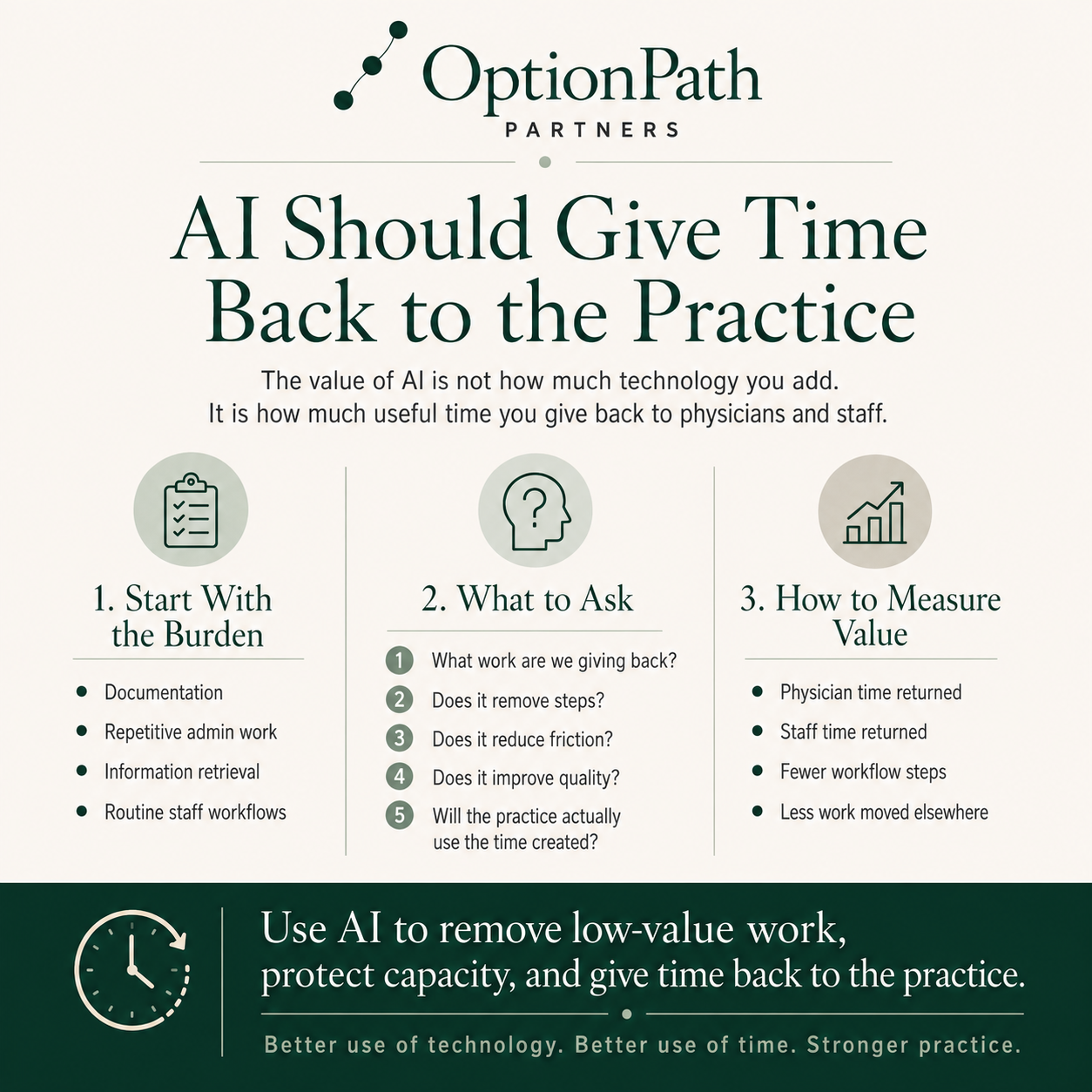
Artificial intelligence is quickly becoming part of the conversation in nearly every physician group. The potential is significant: faster documentation, better information retrieval, reduced administrative work, more efficient patient communication, and improved support for staff and physicians.
But the value of AI should not be measured by how many tools a practice adopts.
It should be measured by how much useful time the technology gives back.
For independent physician groups, that is an important distinction.
The Goal Is Not More Technology
Practices already operate in a technology-heavy environment. Physicians and staff move between the EHR, scheduling systems, revenue-cycle platforms, communication tools, portals, reporting systems, and vendor applications throughout the day.
Adding AI to that environment can create meaningful leverage. It can also create another layer of complexity.
The test should therefore be practical: does the technology remove work, reduce friction, or improve the quality of a task that already needs to happen?
If an AI tool saves three minutes on a task but creates another approval step, another inbox, or another system to monitor, the net benefit may be small. If it meaningfully reduces documentation time, eliminates repetitive administrative work, or helps staff resolve routine issues more efficiently, the benefit is much clearer.
AI should simplify the work, not simply change where the work occurs.
Physician Time Is the Highest-Value Opportunity
Physician capacity is one of the most constrained resources in an independent practice. Too much of it is routinely consumed by work that does not require physician judgment.
Documentation is an obvious example, but the opportunity is broader. Physicians spend time reviewing routine messages, searching for information, preparing communications, completing administrative tasks, and moving information between systems.
AI can help reduce some of that burden, but only if the practice begins with the right question:
What work are we trying to give back to the physician?
That is a more useful starting point than asking which AI tool the practice should buy.
The same principle applies to staff. If AI can reduce repetitive work, improve access to information, or make common workflows easier, it can create capacity without simply adding headcount.
Start With the Burden
Before evaluating an AI solution, leadership should identify where time is actually being lost.
Where are physicians performing repetitive administrative work? Where are staff re-entering information, searching across systems, or answering the same questions repeatedly? Which workflows generate unnecessary handoffs? Where are delays caused by information that exists but is difficult to access?
Those questions point toward use cases that matter.
They also help the practice distinguish between an interesting technology and a useful operating solution.
A compelling demonstration is not the same as measurable value. The best AI use cases should solve a recognizable problem and make the work meaningfully easier for the people doing it.
Measure Time Returned, Not Features Added
AI vendors will continue to introduce more capabilities. Independent practices do not need to adopt all of them.
A better scorecard is simpler:
- How much physician time is being returned?
- How much staff time is being returned?
- Has the number of steps in the workflow decreased?
- Has quality or consistency improved?
- Has the tool reduced work, or simply moved it somewhere else?
- Is the organization actually using the capacity that was created?
That last question matters. Saving time has value only if the practice uses that capacity intentionally, whether for patient care, improved access, leadership responsibilities, or a more sustainable workday.
AI Is an Operating Tool
AI should not sit outside the operating model of the practice. Like any other technology, it changes how work is performed, who performs it, and sometimes where responsibility belongs.
That means leadership needs to consider workflow, role design, oversight, quality, privacy, and accountability alongside the technology itself. A tool may be capable of performing a task, but the practice still needs to decide how that task should fit into the broader organization.
Used well, AI can create meaningful capacity.
Used poorly, it can become one more thing people have to manage.
For independent physician groups, the objective should be straightforward:
Use AI to remove low-value work, protect physician and staff capacity, and give time back to the practice.
Leave a Reply