
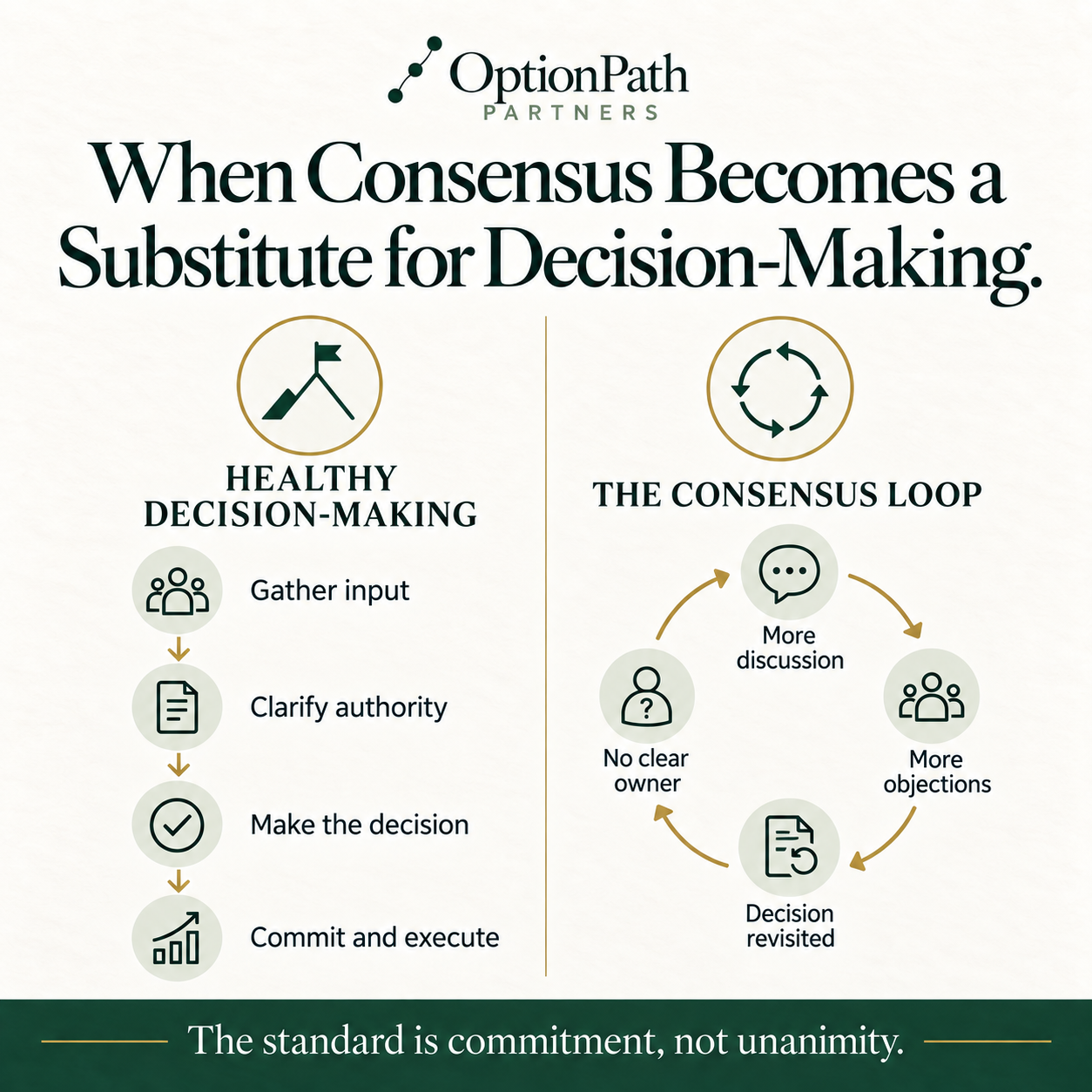
Agreement can strengthen a decision. Requiring it can prevent one.
Consensus sounds like good governance. It suggests that people were heard, differences were resolved, and the organization can move forward together. In a physician partnership, where colleagues may also be equal owners, seeking agreement can feel especially appropriate.
But consensus has a limit. When every meaningful decision must satisfy every stakeholder, the search for alignment can become a way to avoid deciding. Meetings continue, objections are revisited, and leaders wait for an agreement that may never arrive.
At that point, consensus is no longer strengthening the decision. It is substituting for one.
Input, Agreement, and Decision Are Different
Good decisions often require broad input. Leaders need to understand clinical implications, operational constraints, financial tradeoffs, and the effect on physicians and staff. Listening is not a sign of weak authority. It is part of exercising authority responsibly.
But gathering input does not mean everyone must agree. A group can understand the facts, express legitimate concerns, and still reach different conclusions. The decision-maker’s responsibility is to weigh those perspectives and choose a direction.
Confusing consultation with consent gives every participant an informal veto. It also makes accountability difficult. If everyone had to agree, who actually owns the result?
Why Consensus Becomes the Default
Physician groups rarely adopt consensus because they want to become indecisive. The pattern usually develops for understandable reasons.
Equal ownership can be interpreted as equal authority over every issue. Long-standing professional relationships can make direct disagreement uncomfortable. Leaders may fear that a contested decision will damage the partnership. In other cases, decision rights were never defined, so consensus becomes the safest available process.
The problem is that safety is temporary. Avoiding a difficult choice does not eliminate its consequences. It simply allows delay, inconsistency, or informal workarounds to make the decision instead.
The Signs Are Usually Visible
Consensus has become a substitute for decision-making when:
- the same issue returns to multiple meetings without new information
- no one can identify who has final authority
- an absent stakeholder can reopen a settled decision
- routine operating matters require approval from the full partnership
- the least comfortable participant effectively determines the pace
- leaders describe a decision as “the group’s” but no one owns implementation
These patterns consume time, but the larger cost is organizational. Managers learn to wait. Leaders become reluctant to act. Difficult issues move upward, and accountability becomes distributed so broadly that it effectively disappears.
Consensus Has an Appropriate Place
None of this means consensus is unimportant. Some decisions warrant a high level of owner agreement because they alter the fundamental bargain among the partners. Changes in ownership, physician compensation philosophy, major capital commitments, mergers, and decisions that materially affect clinical standards may appropriately require a supermajority or unanimous vote.
That is not consensus by default. It is a deliberate governance choice. The organization has identified a class of reserved decisions and established the approval threshold in advance.
Most operating decisions should function differently. The appropriate leader gathers input from the people with relevant knowledge, decides within defined authority, explains the rationale, and remains accountable for execution and results.
Disagreement Is Not a Governance Failure
One reason groups overuse consensus is the belief that a good process should eliminate disagreement. It will not. Reasonable people can review the same facts and prefer different paths.
Strong governance does not promise that everyone will support every decision. It promises that people will know how the decision will be made, who will make it, what input will be considered, and how the result will be evaluated.
Once a decision is made, continued debate should require new information or a material change in circumstances. Discomfort alone is not evidence that the process failed.
The Standard Is Commitment, Not Unanimity
Healthy organizations do not need universal agreement before they act. They need disciplined participation before the decision and professional commitment after it.
That means leaders must create room for candor, particularly when the stakes are high. It also means participants have a responsibility to distinguish between being unheard and being overruled. Those are not the same experience.
Consensus can be valuable when it emerges from a strong decision process. It becomes dangerous when it is the only acceptable outcome.
The goal is not to make decisions with less input. It is to make clear decisions after the right input, through the right authority, with visible accountability for what happens next.
When no one is willing to decide without complete agreement, consensus has stopped serving leadership. It has replaced it.
Leave a Reply