
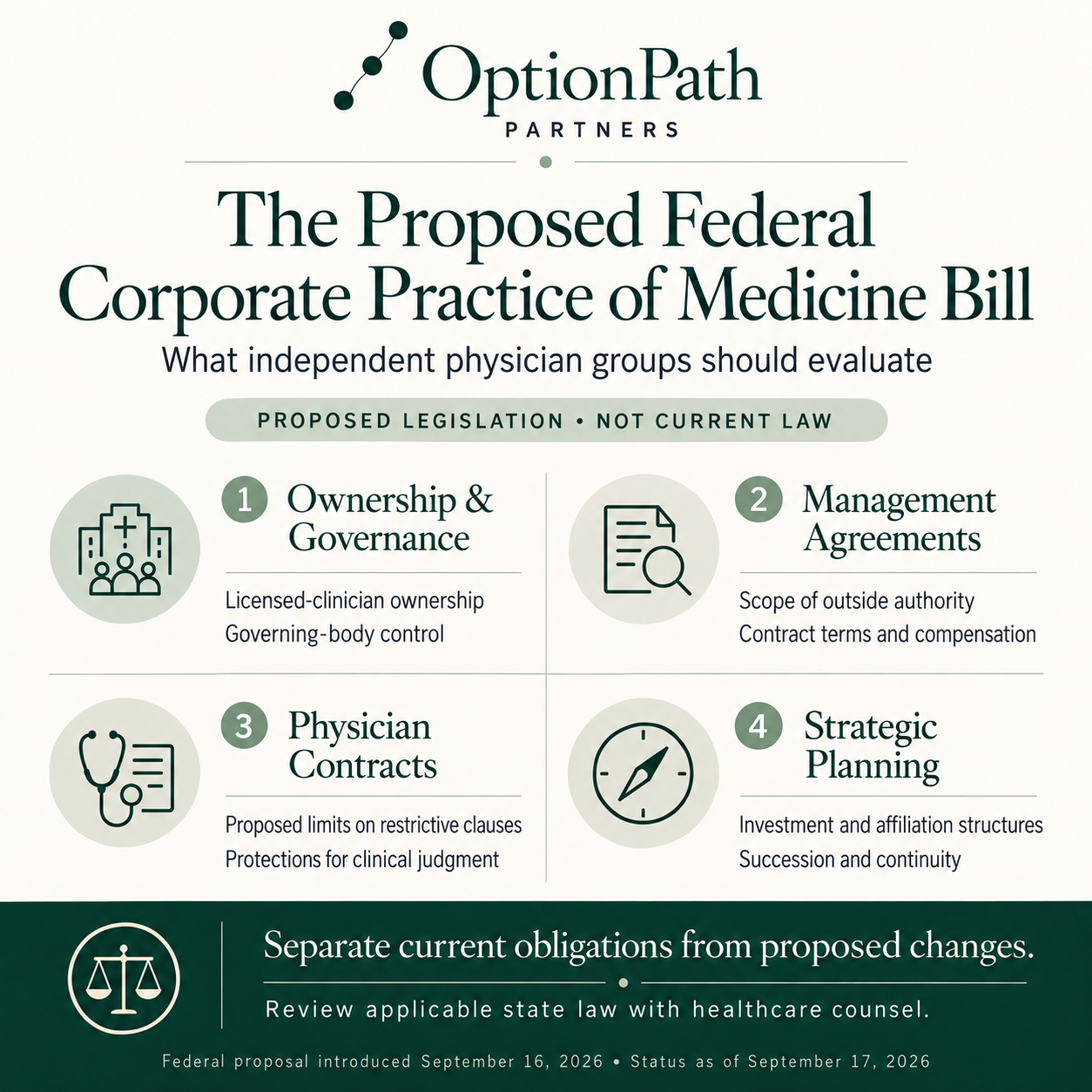
For independent physician groups, ownership is only one part of independence. The practical question is who has the authority to make decisions about the practice, its clinicians, and the care it delivers.
A newly introduced federal proposal brings that distinction into focus.
On September 16, 2026, lawmakers introduced the Stop Corporate Takeovers of Physicians Act of 2026, proposing federal restrictions on medical practice ownership, management services organizations, and interference with clinical judgment. As of September 17, it is proposed legislation, not an enacted requirement. Its final language, timing, and prospects remain uncertain. Official introduction announcement
For practice leaders, the immediate task is not to reorganize around a bill that has not passed. It is to understand what the proposal addresses, distinguish it from applicable state law, and identify which existing arrangements deserve closer review.
What the Proposal Would Change
The released bill would generally require covered medical practices to have both majority ownership and majority governing-body representation held by qualifying licensed clinicians. It also specifies that licensee owners must be licensed and present in a state where the practice furnishes services and substantially engaged in delivering medical care.
Certain providers, including hospitals and hospital-affiliated clinics, are exempt from the ownership prohibition. Those exceptions do not necessarily exempt them from every other provision.
The bill also proposes extensive restrictions on MSO involvement, including control over share transfers and ultimate authority over specified operating decisions. Management agreements would require independent, arm’s-length negotiation and compensation reflecting fair market value. If enacted as released, the requirements would take effect one year after enactment, while preserving equally or more protective state laws. Released bill text
These provisions would make the relationship between ownership, governance, and management central to evaluating a practice’s structure.
Physician-Owned Does Not Necessarily Mean Unaffected
It would be easy for an independent group to read the headlines and conclude that the proposal concerns only private-equity-backed practices.
That would be too narrow.
In her Elevare Law analysis, Rebecca Gwilt explains that the proposal extends beyond the source of investment capital. Its contract and clinical-autonomy provisions could reach physician-owned groups without outside investors.
For example, the bill proposes restrictions on clinician noncompete, nondisclosure, and nondisparagement agreements. Its noncompete provision includes an exception for a clinician holding at least a 25% ownership interest in the practice. The distinction could matter for groups with employed physicians, smaller ownership stakes, or staged partnership arrangements.
The released language would also protect individual clinical judgment in areas such as patient visit time, diagnosis coding, and available clinical orders. These provisions warrant review separately from the ownership requirements.
For independent groups, this creates questions about employment agreements, succession planning, and the relationship between group-wide operating expectations and individual clinical judgment. It does not establish that current agreements are automatically invalid.
State Requirements Remain the Immediate Compliance Issue
The federal proposal should not distract groups from the laws that already apply where they operate.
California’s enacted SB 351, for example, restricts specified forms of private-equity and hedge-fund interference with physician and dental practices. It addresses clinical judgment and certain operating decisions, including payer-contracting parameters and coding and billing.
Importantly, California’s language distinguishes outside assistance from outside control. It expressly permits assistance or consultation on specified decisions when the physician or dentist retains ultimate responsibility or approval. California SB 351
That distinction is useful, but it should not be treated as a universal rule. Different jurisdictions have different requirements, definitions, and exceptions. A multistate group needs a state-specific review rather than a single national assumption.
Review Authority, Not Just the Ownership Chart
A practice’s ownership chart may identify who holds equity without explaining who actually controls important decisions.
An independent group’s review should therefore consider both its documents and its daily operating practices:
- Who appoints or replaces practice leadership?
- Who approves clinician hiring and termination?
- Who establishes staffing and scheduling expectations?
- Who approves payer contracts and financial commitments?
- Who controls access to revenue, records, and essential systems?
- Which decisions are reserved to physician leadership?
- Can the group change service providers without losing operational continuity?
These are diagnostic questions, not a list of activities that are universally prohibited.
The objective is to identify discrepancies between formal authority and practical authority. A contract may reserve approval to the group while the operating process leaves leadership without the information, access, or realistic ability to exercise it.
That gap deserves attention regardless of the federal bill’s outcome.
Outside Support Requires Careful Structuring
Independent physician groups need capable financial, operational, technology, workforce, and executive support. The relevant question is how those relationships are structured.
Practice leaders should not assume that calling a provider a consultant, executive partner, or administrative vendor resolves the legal analysis. The proposed federal definition of an MSO is broad enough to warrant review of compensated business-service arrangements, not only conventional acquisition platforms.
Similarly, leaders should not conclude that all outside assistance would be prohibited. The scope of services, retained authority, contractual terms, and applicable law require careful analysis.
Before entering or renewing a significant arrangement, the group should understand what the provider will recommend, what it will execute, what authority it will hold, and which approvals remain with practice leadership.
Healthcare counsel should assess the legal boundaries. Practice leadership should ensure those boundaries are reflected in how the relationship actually works.
Preserve Options Without Assuming Outcomes
The proposal could affect future investment, affiliation, management, and succession arrangements if enacted. However, its introduction alone does not establish that financing will disappear, practice values will decline, or a particular transaction will become unavailable.
For groups considering a major decision, the practical response is to include regulatory uncertainty in the evaluation.
Leadership can ask which parts of a proposed arrangement depend on particular ownership or control rights, whether the agreement addresses changes in law, and what operational disruption a required restructuring might create. Those questions belong alongside valuation, compensation, access to capital, and the group’s longer-term objectives.
What Independent Groups Can Do Now
A proportionate response is to inventory ownership and governance documents, employment agreements, management arrangements, and major service contracts. Leadership can then work with healthcare counsel to separate current obligations from provisions that should be monitored.
The broader operating task is to make decision rights explicit, maintain access to essential information and systems, and ensure the group has the capacity to exercise the authority it retains.
At OptionPath Partners, we help independent physician groups clarify strategy, strengthen leadership, and translate decisions into execution, alongside the legal and professional advisors responsible for their areas of expertise.
If your group is evaluating an operating partnership, succession plan, or strategic affiliation, let’s discuss how to organize the decisions and diligence around it.
This article provides general business commentary, not legal advice. Legislative information is current as of September 17, 2026. Groups should consult qualified healthcare counsel about their specific circumstances.
Leave a Reply