
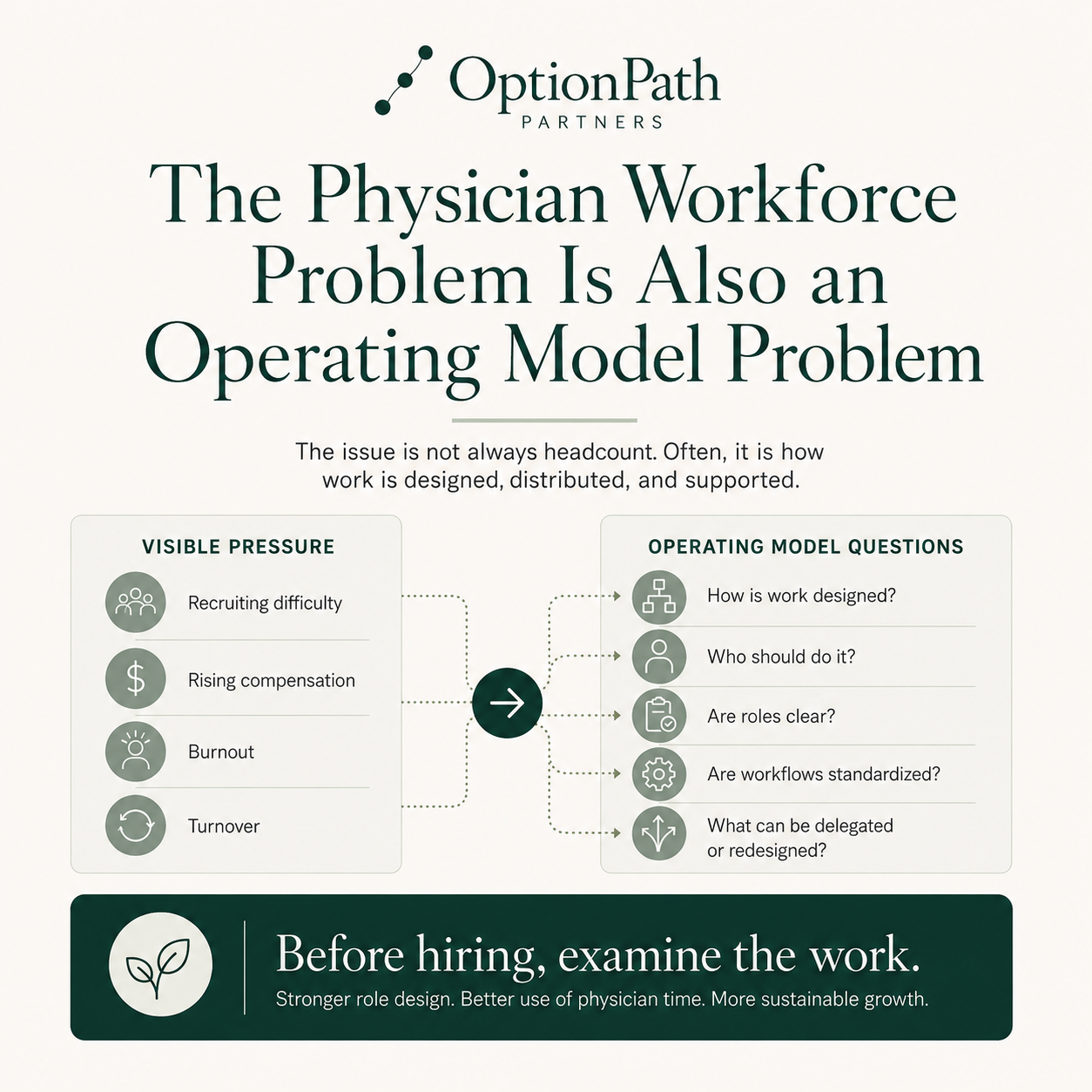
Independent physician groups often describe workforce challenges in familiar terms: not enough physicians, difficulty recruiting, rising compensation, burnout, turnover, and an increasing reliance on advanced practice providers and other clinical staff. Those pressures are real, but they can obscure a second problem that is just as important.
In many practices, the workforce problem is not only a labor-market problem. It is also an operating model problem.
The question is not simply, “How do we find more people?” It is also, “How is the work designed, distributed, and supported today?”
Hiring Does Not Fix Poor Work Design
When a practice feels stretched, the instinct is often to add staff. Sometimes that is exactly the right answer, especially when demand has outgrown available clinical capacity or when a role is clearly missing from the organization.
But hiring should not be the first response to every capacity problem.
Before adding another physician, APP, nurse, medical assistant, or administrator, leadership should understand what work is actually creating the pressure. Are physicians performing tasks that should sit elsewhere? Are administrative responsibilities concentrated in a few partners because no one has clearly assigned ownership? Are workflows different across locations or providers? Are staff members spending time compensating for poorly configured technology or unclear processes?
If the underlying operating model remains unchanged, adding people may increase cost without solving the real problem. The practice becomes larger, but not necessarily more effective.
That distinction matters because labor is expensive, physician capacity is limited, and poorly designed work tends to expand as an organization grows. A practice can therefore find itself hiring repeatedly while the same underlying constraints remain in place.
Physician Time Is an Operating Asset
In most physician groups, physician capacity is one of the organization’s most valuable and constrained resources. Yet physician time is often treated as though it were unlimited.
Clinical responsibilities compete with inbox management, staffing issues, scheduling questions, vendor decisions, meetings, recruiting, partner concerns, quality initiatives, and countless operational interruptions. Over time, those responsibilities accumulate, often without anyone deliberately deciding that physicians should own them.
The result is predictable. Physicians work longer hours, administrative work gets completed inconsistently, and the organization begins to depend on individual effort rather than a deliberate operating structure.
That is not only a burnout problem. It is an operating-design problem.
A stronger model starts by asking what work truly requires physician judgment and what can be redesigned, delegated, automated, standardized, or eliminated. The objective is not to remove physicians from leadership. It is to protect physician capacity for the work where their judgment adds the most value.
Role Clarity Matters as Much as Headcount
Many growing practices add people faster than they clarify roles. That creates a different kind of capacity problem.
Two people may believe they own the same decision, or no one may believe they own it. A practice administrator may be responsible for execution but lack the authority to decide. Physician leaders may continue stepping into routine operational issues because they are unsure where responsibility sits. APPs may be added without a clear redesign of physician workflows, while new managers inherit responsibilities organically rather than intentionally.
At that point, the organization can have more employees and still feel understaffed.
The issue is not necessarily the number of people. It is whether responsibilities, authority, workflows, and accountability are aligned.
This is why staffing decisions should be tied to role design. Adding another person into an unclear structure can create more handoffs, more coordination requirements, and more ambiguity. A well-designed role, by contrast, should make ownership clearer and remove unnecessary work from someone else.
Growth Exposes Weaknesses That Were Already There
Small practices can often operate effectively through informal relationships and individual effort. People know one another, physicians step in when needed, and many decisions can be handled through conversation rather than structure.
As the group grows, those informal systems become harder to sustain. More physicians create more scheduling complexity. More locations create more variation. More service lines create more coordination demands. More employees create more management requirements, and more partners create more governance questions.
The practices that struggle are not always the ones growing fastest. They are often the ones trying to support a larger organization with an operating model designed for a smaller one.
This is one reason workforce pressure can be so informative. It may be a signal that the organization itself needs to evolve.
A practice that once functioned well with physician owners handling staffing issues, approving operational exceptions, and resolving day-to-day problems may eventually need clearer management authority, more consistent workflows, or a different leadership structure. The challenge is recognizing that point before the solution becomes simply “hire more people.”
Before Hiring, Examine the Operating Model
When leaders believe they need more people, they should first understand the constraint they are trying to solve.
Several questions are worth asking:
- What work is creating the constraint?
- Who is doing that work today?
- Does the work require the skill level of the person currently performing it?
- Are responsibilities and decision rights clear?
- Are workflows standardized where they should be?
- Is technology reducing work or simply moving it around?
- Which tasks can be delegated, redesigned, automated, or stopped?
- Where is the organization overly dependent on physicians?
These questions do not assume the answer is fewer people. The practice may still conclude that additional capacity is necessary. The difference is that leadership will be hiring against a defined need rather than using headcount as a substitute for operating discipline.
That is a much stronger position from which to recruit, because it also clarifies what the new person is expected to accomplish and how the role should fit into the organization.
Workforce Strategy and Operating Strategy Are the Same Conversation
Physician groups cannot separate workforce planning from operating design. The people a practice needs depend on how the practice intends to work.
A well-designed operating model clarifies which roles matter, where physician time should be protected, where leadership capacity is needed, and how responsibilities should move as the organization grows.
That does not eliminate the broader physician workforce shortage, nor does it make recruiting easier. It does, however, help independent groups make better use of the talent they already have and avoid adding cost without addressing the underlying problem.
For independent practices competing in a constrained labor market, that distinction matters. A stronger operating model can improve physician capacity, create clearer roles, strengthen management accountability, and make growth more sustainable.
Sometimes the answer is to hire.
Sometimes the better first move is to redesign the work.
Leave a Reply