
Why preserving physician ownership requires clearer leadership, not broader involvement in every decision
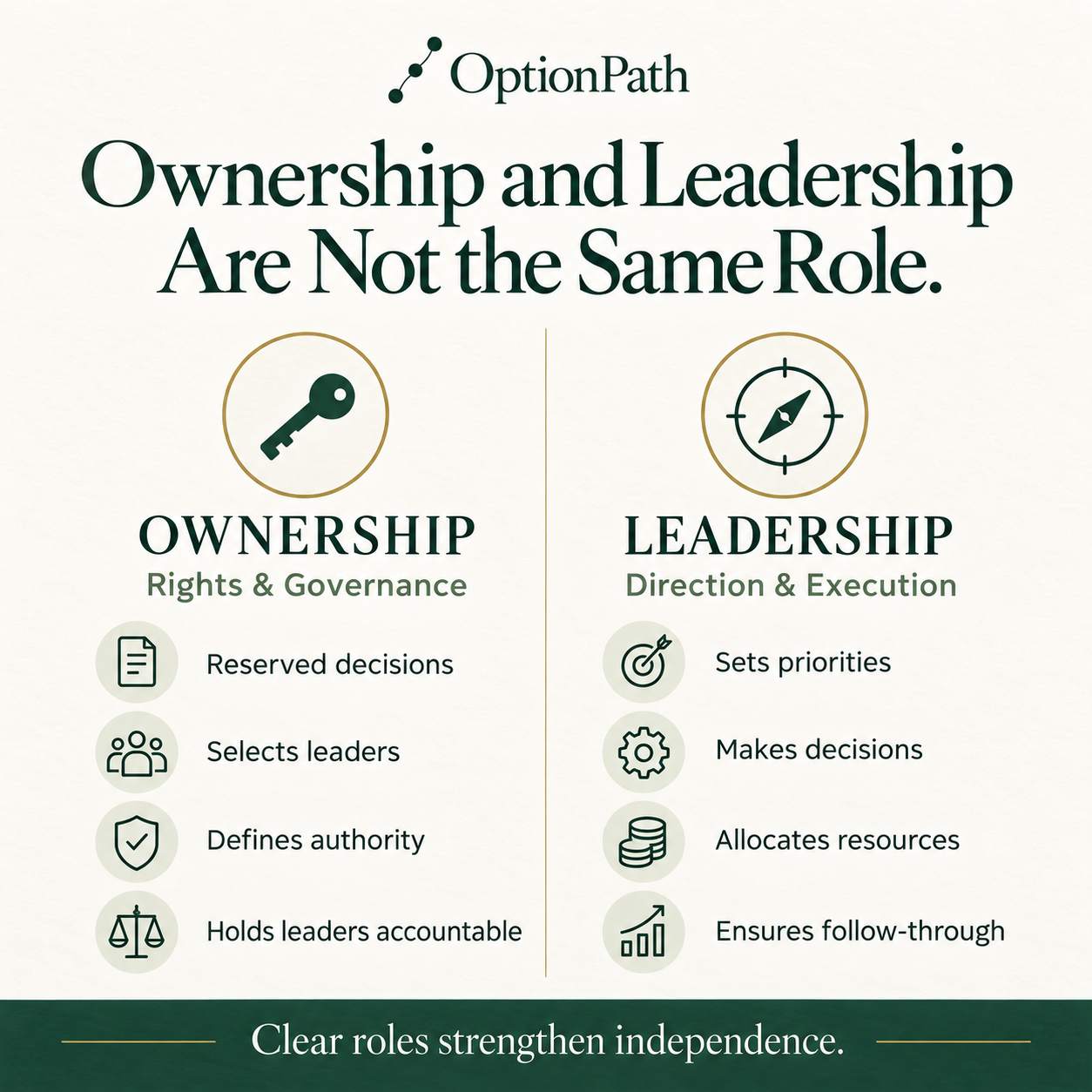
Ownership creates rights. Leadership creates direction, decisions, accountability, and follow-through.
In an independent physician group, ownership and leadership often sit in the same room. The partners own the practice, elect a board, serve on committees, and may also hold operating roles. That overlap can be a strength. It can also create confusion about who is responsible for what.
Ownership gives physicians an economic interest and a legitimate voice in the direction of the enterprise. Leadership is different. Leadership is the ongoing work of setting priorities, making decisions, allocating resources, resolving tradeoffs, and holding the organization accountable for results.
The two should reinforce each other, but they are not interchangeable.
Ownership Answers One Question. Leadership Answers Another.
Ownership answers: Who ultimately controls the organization and benefits from the value it creates?
Leadership answers: Who is accountable for moving the organization forward?
When those questions are blurred, ownership can become a substitute for leadership. Every partner feels entitled to participate in every decision. Leadership roles exist on paper but lack clear authority. Decisions are delegated and then revisited. Managers wait for physician approval because no one is certain where their authority begins or ends.
The result is not stronger physician governance. It is slower decision-making, inconsistent execution, and a practice that depends on informal influence rather than a clear operating model.
What Owners Should Own
Physician owners should retain authority over the matters that define the character, risk, and future of the practice. Depending on the organization, those reserved decisions may include changes in ownership, major capital commitments, partner admission or removal, physician compensation principles, significant transactions, and decisions that materially affect clinical standards or professional culture.
Owners also have a responsibility to establish the governance structure. They select leaders, define the authority attached to each role, approve the boundaries within which leadership may act, and evaluate whether the organization is producing the intended results.
That is meaningful work. It does not require every owner to participate in every operating decision.
What Leaders Must Lead
Once direction and decision rights are clear, leaders need room to lead. They must translate the owners’ priorities into plans, establish operating expectations, make decisions within their authority, and ensure that agreed actions are carried through.
This applies whether the leader is a physician president, managing partner, executive director, administrator, or non-physician executive. The title matters less than the clarity of the mandate.
A leadership role without authority is ceremonial. Authority without accountability is dangerous. Effective leadership requires both.
The strongest physician-owned groups do not ask leaders to seek consensus on every issue. They expect leaders to gather appropriate input, exercise judgment, communicate decisions, and remain accountable for the consequences.
Equal Ownership Does Not Require Equal Operating Authority
This distinction can be uncomfortable in a partnership. Physicians may hold equal ownership interests while contributing differently to leadership. One partner may be well suited to clinical governance, another to growth strategy, and another may prefer to focus on patient care. Equal standing as owners does not mean each person should have equal authority over every function.
Treating all owners as interchangeable operating leaders may feel equitable, but it often produces the opposite outcome. Responsibility becomes diffuse. Difficult decisions are delayed. Strong leaders are constrained, while less-engaged owners retain informal veto power without carrying equivalent accountability.
A fairer structure separates the rights of ownership from the responsibilities of leadership. Owners retain appropriate protections and reserved authority. Leaders receive defined decision rights and are evaluated against clear expectations.
Structure Protects Both Ownership and Leadership
The solution is not to reduce the voice of physician owners. It is to make that voice more intentional.
A well-designed governance model should answer a few practical questions:
- Which decisions are reserved for the full ownership group?
- Which decisions belong to the board or a designated committee?
- Which decisions are delegated to an individual physician or executive leader?
- What input is required before a decision is made?
- How will leaders report results and be held accountable?
- What happens when a decision falls outside an established boundary?
These questions do more than create administrative clarity. They protect the partnership from overreach, protect leaders from constant second-guessing, and allow decisions to be made at the appropriate level.
Clear Leadership Strengthens Independence
Independent physician groups often treat ownership as the defining feature of independence. It is an essential feature, but ownership alone does not create a strong enterprise.
Independence becomes durable when physician owners can govern without having to personally administer everything, when leaders can act without repeatedly renegotiating their authority, and when accountability is built into the structure rather than dependent on personality.
The goal is not to separate physicians from the practice they own. It is to distinguish the decisions that require ownership authority from the work that requires leadership responsibility.
Ownership determines who has the right to decide the future. Leadership determines whether the organization can build it.
Leave a Reply